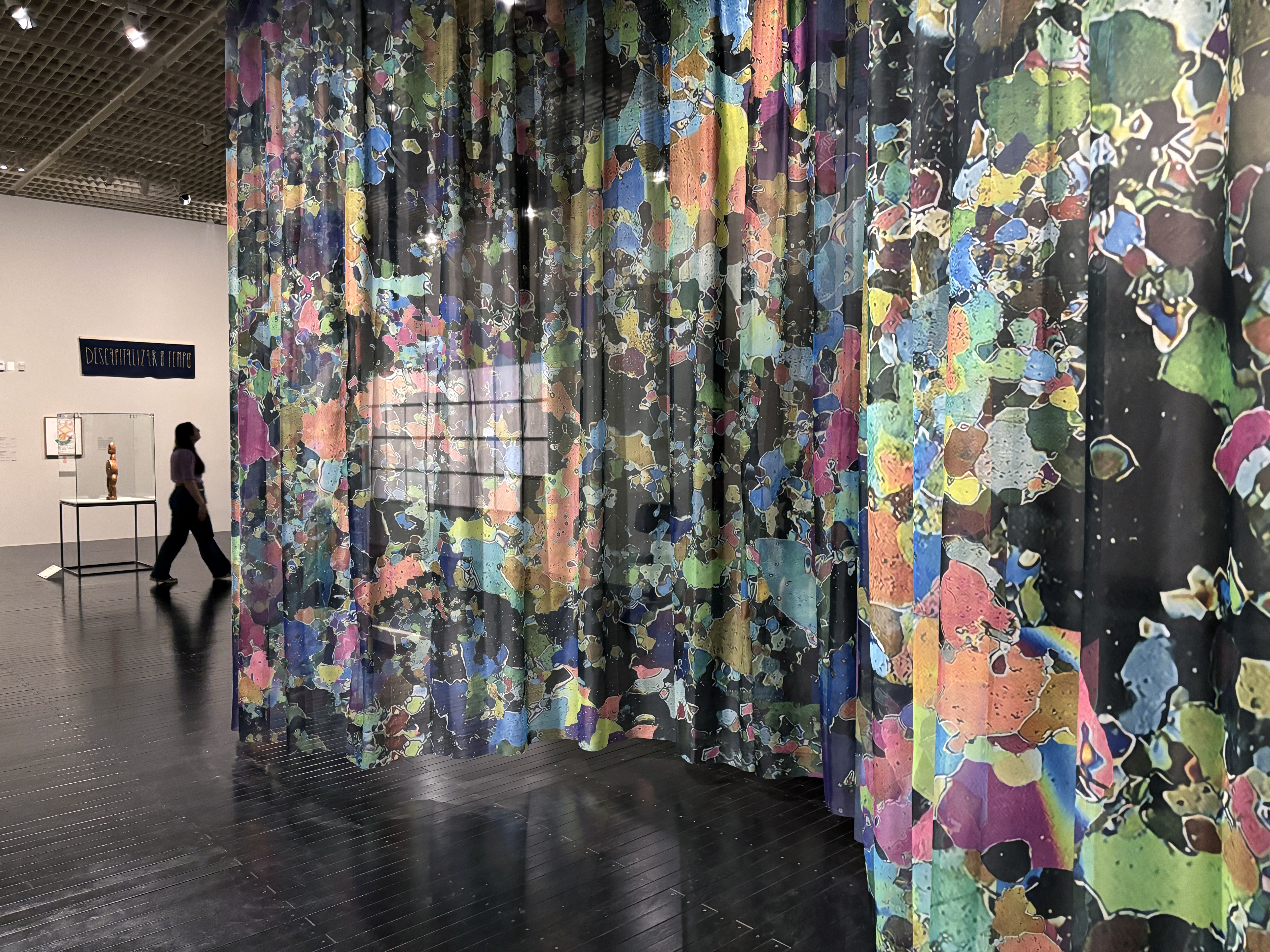


And time stood still until it disappeared. 2025
From the exhibition Histories of Ecology
(04.09.2025-01.02.2026)
Museu de Arte de São Paulo (MASP), Brazil
Curated by Isabella Rjeille & André Mesquita.
In the collection of MASP.
From the exhibition Histories of Ecology
(04.09.2025-01.02.2026)
Museu de Arte de São Paulo (MASP), Brazil
Curated by Isabella Rjeille & André Mesquita.
In the collection of MASP.
The work And time stood still until it disappeared, is based on a microscopic picture of an ice core sample from Grímsvötn, Vatnajökull glacier. This particular ice core dates back to 1950, recording precipitation, dust, minerals, ash, airbubbles, biologic material and pollution.
The ice cores were photographed by Þorsteinn Þorsteinsson, glaciologist in 2002.
The textile installation is a 20 metre long collage, printed on 100% nylon as a reference to the discovery of microplastic in the ice.
“The climate crisis challenges our notions of space and time.' Its impacts and the ways to minimize them require short-, medium-, and long-term planning action. This section thus gathers various works that address different ways of experiencing time, space, and the changes we cause to them: from the time defined by the cosmos that govern life on Earth to the time defined by capitalism, which dictates increasingly accelerated rhythms.
The distinctions between geological and human time have collapsed in the era we currently live in, which some scientists refer to as the Anthropocene. The work And time stood still until it disappeared (2024), by Þorgerður Ólafsdóttir, starts from this observation. The installation consists of a collage built from the image of a sample taken from the active sub-glacial volcano Grímsvötn, located under the Vatnajökull glacier in Iceland.
Images like this one, taken with a microscope by glaciologist Þorsteinn Þorsteinsson in 2002, provide data on precipitation, ash presence, and pollution - the glacier then functions as an atmospheric archive of that region.
Microplastics were first detected in images of glacier ice in the mid-20th century -when polyester began to be produced on a large scale, fueling the fashion industry. Ólafsdóttir appropriates one of these images and prints it on polyester fabric, completing a temporal and spatial arc that reinforces the excessive, permanent, and almost imperceptible presence of this material in our lives - from our clothes to the water in glaciers.”
- Isabella Rjeille, curator
In the same year Brazil hosts COP30, the United Nations Climate Change Conference in Belém, Pará, MASP presents the exhibition Histories of Ecology. This is the museum’s eighth exhibition since 2016 dedicated to exploring diverse, plural, and polyphonic histories. The show is not a direct response to the conference but rather proposes a broader perspective. Moving beyond the undeniable urgency of the climate crisis, the exhibition expands the concept of ecology itself. Through the work of artists, activists, and social movements, it examines the relationships between human and more-than-human beings—a category that encompasses animals, plants, rivers, forests, mountains and fungi.
The use of the term “ecology” instead of “nature” is, in this context, a deliberate conceptual decision. Unlike conceptions that isolate nature as an entity external to society, ecology is understood here as a relational web, a field of forces in constant transformation. This perspective challenges established dichotomies such as nature/culture, subject/object, and human/non-human. Such an approach resonates with contemporary calls for an “ecological turn” within the humanities and social sciences, which seek to rethink knowledge production by embracing a multiplicity of worlds and ecosystems.